
Quantum computing and artificial intelligence are converging to redefine how massive datasets are processed and how neural networks are trained. While classical computing has powered modern AI, exponential data growth is pushing conventional hardware to its limits.
Quantum computing introduces qubits that exploit superposition and entanglement, enabling complex computations to be explored in parallel. While practical fault-tolerant quantum computers are still developing, hybrid quantum-classical systems are already demonstrating promising results for optimization, sampling, and machine learning research.
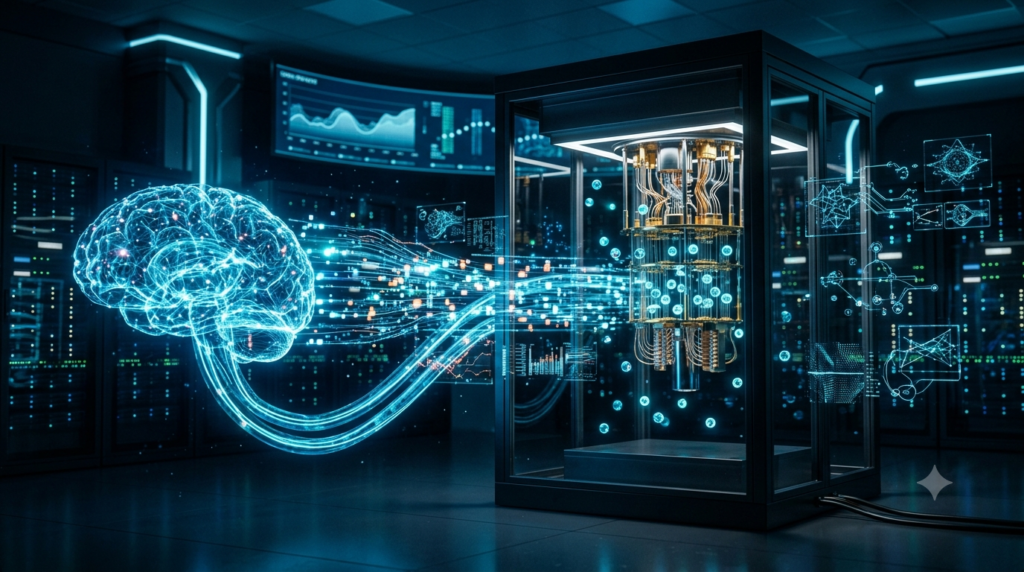
Accelerating Neural Network Training
Training deep neural networks requires enormous computational resources, as billions of parameters must be optimized using huge datasets. Quantum algorithms may accelerate parts of these workflows, especially:
- Optimization algorithms improving parameter convergence and accuracy.
- Feature mapping into high-dimensional quantum states.
- Probabilistic modeling for enhanced generative AI models.
The Hybrid Approach
Hybrid approaches allow classical GPUs and CPUs to manage the majority of the workload, while quantum processors solve specific, highly complex subproblems that remain difficult for conventional hardware.
Real-World Industry Applications
Industries across the globe are investing heavily in Quantum-AI research. Faster optimization and improved processing power offer breakthroughs in:
- Healthcare & Drug Discovery: Enhanced medical imaging and molecular simulations.
- Finance: Advanced portfolio analysis and risk management.
- Logistics: Dynamic supply-chain routing and optimization.
- Cybersecurity: Superior fraud detection and pattern recognition.
As quantum hardware matures, AI models are expected to become faster, more accurate, and significantly more energy-efficient.
Challenges and the Road Ahead
Despite rapid progress, key technical challenges remain before widespread adoption is realized:
- Qubit stability and decoherence
- Quantum error correction
- Hardware scalability
- Programming and algorithmic complexity
Nevertheless, active research continues to push the field forward. Many experts agree that the future belongs to hybrid architectures, where quantum processors complement—rather than replace—existing classical computing infrastructure.
Authoritative Resources & Hyperlinks
To explore the rapidly evolving Quantum-AI ecosystem, check out the platforms, software frameworks, and educational materials published by industry leaders:
Key Takeaway: Quantum-AI fusion continues to evolve through advances in optimization, machine learning, quantum algorithms, scalable hardware, and interdisciplinary research that will shape the next generation of intelligent computing systems.

admin
SEO Strategist & Link Building Specialist at SERP Xperts.
Leave a Reply